
Share John Watts Young's obituary with others.
Invite friends and family to read the obituary and add memories.
Stay updated
We'll notify you when service details or new memories are added.
You're now following this obituary
We'll email you when there are updates.
Select your format and elements to print

IN LOVING MEMORY OF John Watts Young
John Watts
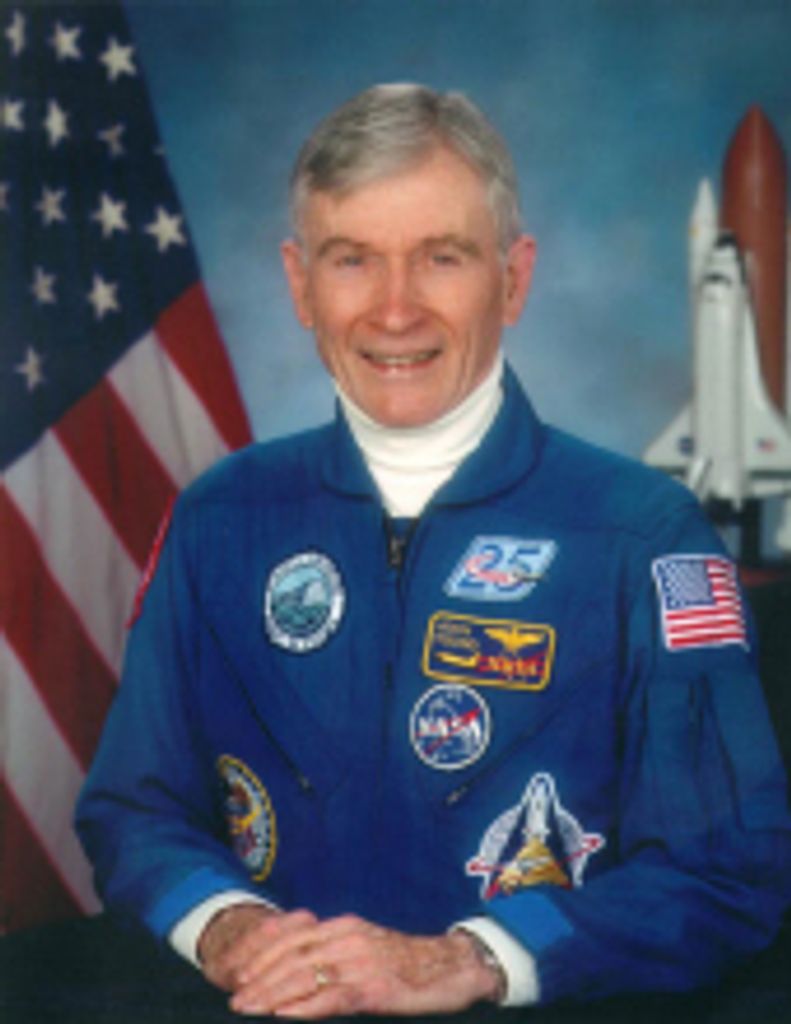
Young
September 24, 1930 — January 5, 2018
John Watts Young's Obituary
John Watts Young United States Astronaut. He participated in the Gemini, Apollo, and space shuttle programs and was the first astronaut to make six spaceflights. After graduating from the Georgia Institute of Technology in 1952 with a degree in aeronautical engineering, he joined the United States Navy. He served in Korea before participating in a test project, during which, in 1962, he set two time-to-climb records in a Navy F-4B jet. From 1962 to 1964, he trained to be an astronaut with NASA (National Aeronautics and Space Administration). His first space flight came in March of 1965 on Gemini 3, which reached a maximum altitude of 139 miles on its first of three orbits. After 4 hours and 53 minutes, Gemini 3 landed in the South Atlantic Ocean. After the flight, he was awarded the NASA Exceptional Service medal by President Lyndon B. Johnson. On July 18, 1966, he joined Michael Collins on Gemini 10, which docked with an Agena target vehicle. They would attain an altitude of 475 miles, using the Agena's engine. On May 18, 1969, he was aboard Apollo 10, which was the last checkout of the Apollo systems before Apollo 11's moon landing. He was later commander of Apollo 16 in April of 1972, which was the fifth manned landing on the Moon. In 1976 he retired from the Navy, but stayed with NASA, becoming the head of the astronaut office. In 1981 he was the commander of the first space shuttle mission, on board the Columbia with fellow astronaut Robert L. Crippen. Two years later, he commanded the joint NASA and European Space Agency mission aboard Columbia, which carried Spacelab in its payload bay. From 1987 to 2004, he remained with NASA, holding management positions concerned with space shuttle operations and safety at the Johnson Space Center in Houston, Texas. He retired from NASA in 2004. He was awarded the Congressional Space Medal of Honor in 1981.
John Watts Young's Guestbook
This site is protected by reCAPTCHA and the
Google Privacy Policy and Terms of Service apply.
Service map data © OpenStreetMap contributors