
Share Audie Leon Murphy's obituary with others.
Invite friends and family to read the obituary and add memories.
Stay updated
We'll notify you when service details or new memories are added.
You're now following this obituary
We'll email you when there are updates.
Select your format and elements to print

IN LOVING MEMORY OF Audie Leon Murphy
Audie Leon
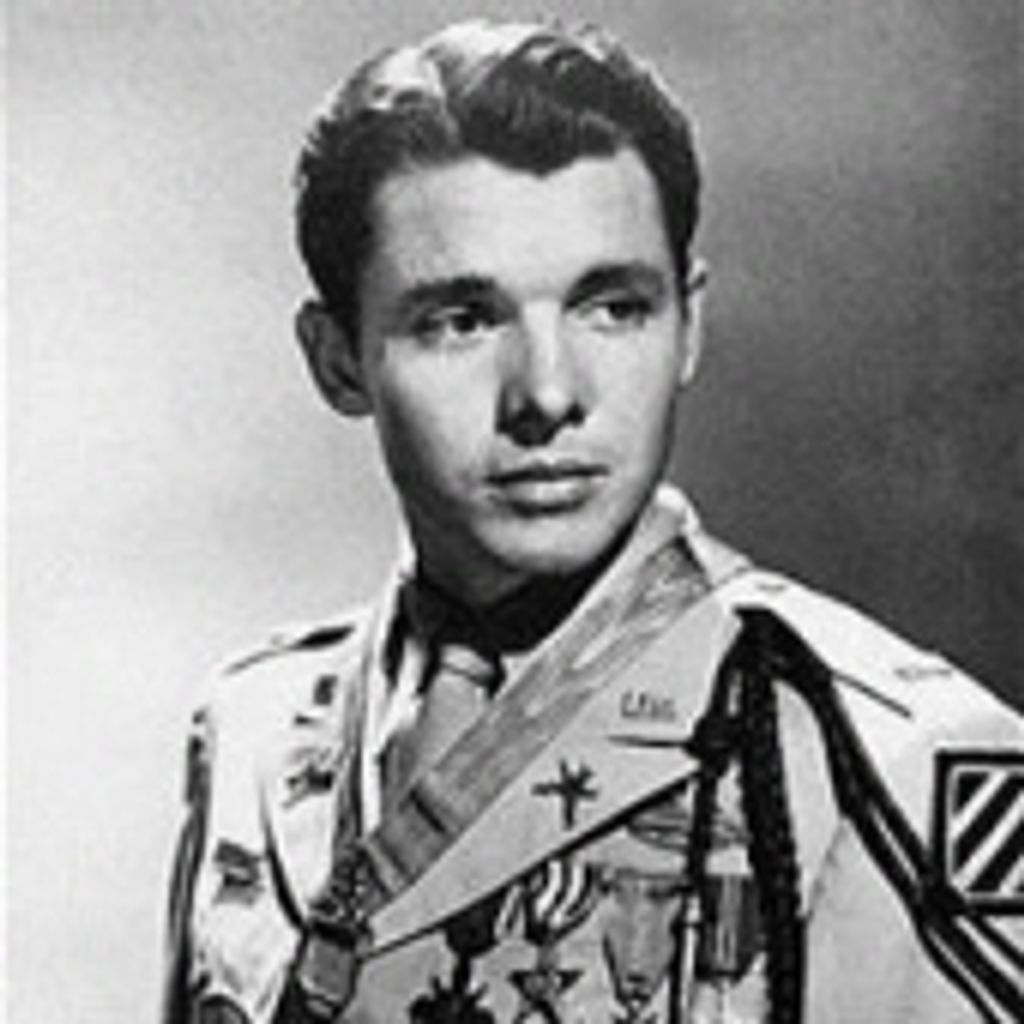
Murphy
June 20, 1925 — May 28, 1971
Audie Leon Murphy's Obituary
Audie Leon Murphy, born June 20, 1925*, son of poor Texas sharecroppers, rose to national fame as the most decorated U.S. combat soldier of World War II. Among his 33 awards and decorations was the Medal of Honor, the highest military award for bravery that can be given to any individual in the United States of America, for 'conspicuous gallantry and intrepidity at the risk of his life above and beyond the call of duty.' He also received every decoration for valor that his country had to offer, some of them more than once, including 5 decorations by France and Belgium. Credited with either killing over 240 of the enemy while wounding and capturing many others, he became a legend within the 3rd Infantry Division. Beginning his service as an Army Private, Audie quickly rose to the enlisted rank of Staff Sergeant, was given a 'battle field' commission as 2nd Lieutenant, was wounded three times, fought in 9 major campaigns across the European Theater, and survived the war. During Murphy's 3 years active service as a combat soldier in World War II, Audie became one of the best fighting combat soldiers of this or any other century. What Audie accomplished during this period is most significant and probably will never be repeated by another soldier, given today's high-tech type of warfare. The U.S. Army has always declared that there will never be another Audie Murphy. On 21 September, 1945, Audie was released from the Army as an active member and reassigned to inactive status. During this same time, actor James Cagney invited Murphy to Hollywood in September 1945, when he saw Murphy's photo on the cover of Life Magazine. The next couple of years in California were hard times for Audie Murphy. Struggling and becoming disillusioned from lack of work while sleeping in a local gymnasium, he finally received token acting parts in his first two films. His first starring role came in a 1949 released film by Allied Artists called, Bad Boy. In 1950 Murphy eventually got a contract with Universal-International (later called Universal) where he starred in 26 films, 23 of them westerns over the next 15 years. His 1949 autobiography To Hell And Back was a best seller. Murphy starred as himself in a film biography released by Universal-International in 1955 with the same title. The movie, To Hell and Back, held the record as Universal's highest grossing picture until 1975 when it was finally surpassed by the movie Jaws. In the mid-60s the studios switched from contract players to hiring actors on a picture-by-picture basis. Consequently, when his contract expired in 1965 Universal did not renew. This gave him the opportunity to work with other studios and independent film producers. In the 25 years that Audie spent in Hollywood, he made a total of 44 feature films. Audie also filmed a 26 episode western television series, known as Whispering Smith which aired on NBC in 1961. Although the series earned good reviews, it was also characterized as unusually violent. Only 20 episodes were aired before the series was cancelled. Despite his success in Hollywood, Audie never forgot his rural Texas roots. He returned frequently to the Dallas area where he owned a small ranch for a while. He also had ranches in Perris, California and near Tucson, Arizona. He was a successful Thoroughbred and Quarter Horse racehorse owner and breeder, having interests in such great horses as 'Depth Charge.' His films earned him close to 3 million dollars in 23 years as an actor. Audie loved to gamble, and he bet on horses and different sporting events. He was also a great poker player. In his role as a prodigious gambler, he won and lost fortunes. Audie Murphy wrote some poetry and was quite successful as a songwriter. He usually teamed up with talented artists and composers such as Guy Mitchell, Jimmy Bryant, Scott Turner, Coy Ziegler, or Terri Eddleman. Dozens of Audie Murphy's songs were recorded and released by such great performers as Dean Martin, Eddy Arnold, Charley Pride, Jimmy Bryant, Porter Waggoner, Jerry Wallace, Roy Clark, Harry Nilsson and many, many others. His two biggest hits were Shutters and Boards and When the Wind Blows in Chicago. Eddy Arnold recorded When the Wind Blows in Chicago for his 1993 album Last of the Love Song Singers which is currently in release by RCA. Audie sufferred from what is now known as Post Traumatic Stress Disorder (PTSD)and was plagued by insomnia and depression. During the mid-60's he became dependent for a time on doctor prescribed sleeping pills called Placidyl. When he recognized that he had become addicted to this prescription drug, he locked himself in a motel room, stopped taking the sleeping pills and went through withdrawal symptoms for a week. Always an advocate for the needs of veterans, he broke the taboo about discussing war related mental problems after this experience. In a effort to draw attention to the problems of returning Korean and Vietnam War veterans, Audie Murphy spoke-out candidly about his personal problems with PTSD, then known as 'Battle Fatigue'. He publicly called for United States government to give more consideration and study to the emotional impact war has on veterans and to extend health care benefits to address PTSD and other mental health problems of returning war vets. While on a business trip on May 28, 1971, (Memorial Day Weekend) he was killed at the age of 45*. A private plane flying in fog and rain crashed in the side of a mountain near Roanoke, Virginia. Five others including the pilot were also killed. Although Audie owned and flew his own plane earlier in his career at Hollywood, he was among the passengers that tragic day. Contrasting TV News May 1971 & Oct. 2013 NEWS REPORTS At the time of his death, Audie Murphy was only given a combined total of 1 minute and 30 seconds of news time by the major television news networks ABC, CBS, and NBC. On October 29, 2013 news affiliates of the same major networks would devote nearly 2 minutes each to Audie Murphy when Governor Rick Perry posthumously presented the Texas Legislative Medal of Honor to Audie Murphy. On June 7th, Audie Murphy was buried with full military honors in Arlington National Cemetery. His gravesite, near the Amphitheater, is second most visited gravesite year round. President Kennedy's grave is the most visited. In 1996 the Texas Legislature officially designated his birthday, June 20th, as Audie Murphy Day. On June 9, 1999 Governor George W. Bush, Texas made a similar proclation declaring June 20th to officially be Audie Murphy Day in the state of Texas. On October 29, 2013, Governor Rick Perry posthumously awarded the Texas Legislative Medal of Honor in Farmersville, Texas to Audie Murphy by presenting it to his only surviving sibling, Nadine Murphy in a ceremony held in Farmersville, Texas. *Note on Birthyear: Audie Murphy was born June 20, 1925 and was seventeen when he enlisted. Many sources incorrectly state he was born June 20, 1924. The error is based on confusion created by a falsified birth certificate Audie Murphy filed at the Hunt County, Texas Courthouse, with the help of his older sister, Corrine, so he could join the military before he was legally of age. Audie later admitted, on more than one occasion, that he lied about his age. References corroborating this fact include documents and interviews where Audie admits falsifying his birthday: (1) Audie's 1970 California Driver's license (2) Photoplay, January 1951, page 80; (3) Modern Screen, July 1951, page 70; (4) Modern Screen, July 1955, page 85; (5) Movie Stars Parade, January 1958, page 68; (6) 'The War Hero' by Thomas B. Morgan, Esquire magazine, Vol. 100, No. 6, December 1983 (pages 597-604); (7) 'Helmets in the Dust' by David McClure, circa 1956, based on about 80 pages of writings by Audie Murphy and conversations held between McClure and Murphy states that Audie Murphy joined the Army on his seventeenth birthday, having falsified his age to be eligible for enlistment; and (8) Movie Stars Parade, February 1951, page 85 Audie Leon Murphy (20 June 1925 – 28 May 1971) was one of the most decorated American combat soldiers of World War II, receiving every military combat award for valor available from the U.S. Army, as well as French and Belgian awards for heroism. At the age of 19, Murphy received the Medal of Honor after single-handedly holding off an entire company of German soldiers for an hour at the Colmar Pocket in France in January 1945, then leading a successful counterattack while wounded and out of ammunition. Murphy was born into a large sharecropper family in Hunt County, Texas. His father abandoned them, and his mother died when he was a teenager. Murphy left school in fifth grade to pick cotton and find other work to help support his family; his skill with a hunting rifle was a necessity for putting food on the table. Murphy's older sister helped him to falsify documentation about his birth date to meet the minimum-age requirement for enlisting in the military, and after being turned down by the Navy and the Marine Corps he enlisted in the Army. He first saw action in the Allied invasion of Sicily and the Battle of Anzio, and in 1944 was part of the liberation of Rome and invasion of southern France. Murphy fought at Montlimar, and led his men on a successful assault at the L'Omet quarry near Cleurie in northeastern France in October. After the war Murphy enjoyed a 21-year acting career. He played himself in the 1955 autobiographical To Hell and Back based on his 1949 memoirs of the same name, but most of his films were westerns. He made guest appearances on celebrity television shows and starred in the series Whispering Smith. Murphy was a fairly accomplished songwriter, and bred quarter horses in California and Arizona, becoming a regular participant in horse racing. Suffering from what would today be termed posttraumatic stress disorder (PTSD), he slept with a loaded handgun under his pillow and looked for solace in addictive sleeping pills. In the last few years of his life he was plagued by money problems, but refused offers to appear in alcohol and cigarette commercials because he did not want to set a bad example. Murphy died in a plane crash in Virginia in 1971 shortly before his 46th birthday, and was interred with full military honors at Arlington National Cemetery.
Cemetery Details
LocationArlington National Cemetery Arlington, VA, 22211
Audie Leon Murphy's Guestbook
This site is protected by reCAPTCHA and the
Google Privacy Policy and Terms of Service apply.
Service map data © OpenStreetMap contributors